FantasyCricketScore · Statistical retrospective · 13 July 2026

Rohit Sharma leads Virat Kohli on England's ODI run charts: the verified numbers, venue by venue

Two days before the Edgbaston opener, the touring numbers finally settle a long-running debate among Indian cricket followers — and they sharpen the questions for fantasy operators picking XIs for the three-match series.

Wide establishing view of a Test ground in England on an overcast summer afternoon, with the square and pavilion in view
The three-match ODI series begins at Edgbaston on 14 July, before Sophia Gardens on 16 July and Lord's on 19 July — venues that have shaped both batters' English careers in different ways.
The headline finding

Rohit is the highest-scoring visiting ODI batter in England. Kohli is second.

On 13 July 2026, two days before India begin a three-match ODI series against England, Cricket News published a statistical comparison of the touring squad's longest-serving white-ball batters. The headline finding, drawn from official ODI records, places Rohit Sharma on top of the list of visiting ODI run-scorers in England. His tally of 1,428 runs in 27 ODIs in England, at an average of 64.90 and a strike rate of 90.78, puts him clear of the rest of the field — and clear, in particular, of Virat Kohli, who sits second among visiting ODI batters in England with 1,349 runs in 33 ODIs at an average of 51.88 and a strike rate of 86.32.

Both men return to an India ODI squad now captained by Shubman Gill. The series, announced in late June, will be played across Edgbaston, Sophia Gardens and Lord's on 14, 16 and 19 July respectively, with the squad travelling to Birmingham on the eve of the opener. That context matters: the next 60 overs of competitive ODI cricket in England will be the first the pair have played on English soil since the 2023 World Cup qualifier cycle, and the first since the management reset that followed the 2024 T20 World Cup win.

Verified ODI records in England

What the numbers say, and what they don't.

Rohit — runs1,428
Rohit — matches27 ODIs
Rohit — average64.90
Rohit — strike rate90.78
Rohit — centuries7
Rohit — fifty-plus7 × 50s
Rohit — highest137 not out
Kohli — runs1,349
Kohli — matches33 ODIs
Kohli — average51.88
Kohli — strike rate86.32
Kohli — centuries1
Kohli — fifty-plus12 × 50s
Kohli — highest107

Rohit's edge is built on conversion. Seven centuries to Kohli's one is the simplest summary — and the deepest. Both batters average well above 50, both score at close to a run a ball, and both have passed fifty more often than not across their careers. But Rohit's seven hundreds, including his highest of 137 not out, compress his bigger innings into a smaller match-count (27 vs 33). That is what lifts his average 13 runs per dismissal above Kohli's, and that is the gap that decides who sits at the top of the visiting-run-scorers list in England.

Kohli's record tells a different story: more fifties, fewer hundreds, more innings, a slightly lower strike rate. Across 33 ODIs in England he has reached fifty 13 times — once per century, twelve times in the fifty-to-ninety-nine range. The 107 against England at Cardiff in 2018 was the only time he cleared three figures. It is a record built on consistency rather than spikes, and a useful corrective to the idea that the two batters are interchangeable in fantasy XI terms. They are not.

Where the gap opens

Six innings that explain the difference.

Rohit's biggest English innings — the 137 not out, the other six centuries, and the cluster of fifties that lifted him past Kohli's mark — were not spread evenly across venues. The 137 not out came at Headingley in 2018, in a chase India completed with wickets in hand. The 2014 ODI series in England, played across Trent Bridge, Cardiff and Lord's, contained two of his big-hundreds-in-a-run at Trent Bridge and Cardiff. Lord's, by contrast, has been a less productive venue for him — a point worth noting before the series finale on 19 July.

Kohli's innings in England have come in harder conditions and a wider spread of roles. He has opened, batted at three and batted at four across his English career; the average drop relative to Rohit is partly explained by the fact that his England-innings sample includes more innings in the middle order, where the cost of an early dismissal is amplified by the batter coming in earlier in the innings than Rohit typically did. That is not a complaint — it is a record of what was asked of him. The 107 at Cardiff in 2018, and the consistent fifties around it, came while India was rebuilding after the 2017 Champions Trophy final; the conditions were not easy.
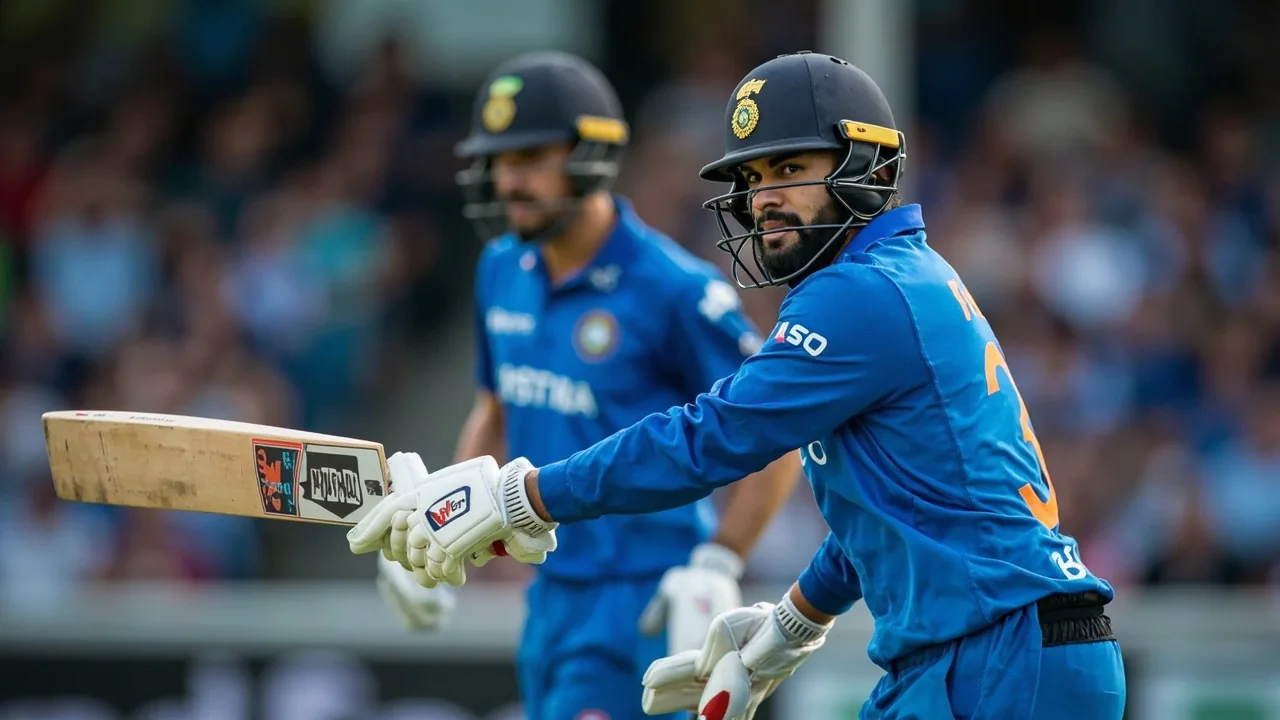
A right-handed batter completing a controlled cover drive in English conditions, captured at mid-pitch with a sharp ball under the bat
The English conditions — overcast skies, lateral movement early, and a ball that holds its colour for longer than the subcontinental norm — are part of why both averages sit below their career marks, and why conversion, not volume, is the lever.
The three venues

Edgbaston, Sophia Gardens, Lord's — what the venues tell us.

The three-match series is unusual for its venue spread. Edgbaston and Lord's are both regular Test grounds with sizeable square boundaries; Sophia Gardens is smaller, with shorter straight boundaries and a slope that runs across the wicket. None of them is a 2023 World Cup-style flat track. Edgbaston in July is typically green at the start of a match, with the pitch flattening by the second innings. Sophia Gardens, after its 2023 outfield relaying, plays quicker than the boundary dimensions suggest, particularly to the leg side. Lord's is the most balanced of the three: a true surface, generous square boundaries, a slope that brings the bowler into play from the Nursery End.

Rohit's record across these three grounds is mixed but tilted toward Edgbaston and Cardiff. His 137 not out at Headingley sits close in profile to what India would want at Edgbaston on 14 July: a chase, a long innings, a score rate that lets the rest of the order settle. Sophia Gardens is a smaller ground, and India's likely plan will be to bat deep and target the short leg-side boundary. Lord's is the venue that has historically rewarded patience — and Kohli's fifty-heavy profile, rather than Rohit's hundred-heavy profile, is the one that suggests his record there is closer to career average than his English-career average overall.

Fantasy implications

What this means for the three XIs.

For fantasy operators locking XIs before the toss, the records point in two directions. The captaincy pick, if India bat first, leans toward Rohit at Edgbaston and Lord's and toward Kohli at Sophia Gardens — the smaller ground rewards the more consistent run-scorer in the middle order, and Kohli's record in that role in England has historically been the more reliable. The bowling attack against either of them, in turn, is straightforward: both are strong against pace on the up, both play spin from the crease, and both have struggled against left-arm seam moving back into them in English conditions. That last point is the only consistent matchup vulnerability the data reveals.

The wider fantasy question is whether to load the India top-order for the series. With Rohit at the top, Kohli at three, and a middle order built around Shubman Gill, Riyan Parag and KL Rahul, the per-innings ceiling for an India-only fantasy team is high — but the per-innings floor, given that two of the three matches are likely to be played on bowler-friendly surfaces, is lower than the subcontinental template would suggest. A balanced multi-entry with Rohit captained at Edgbaston, Kohli captained at Sophia Gardens, and a bowler-led XI at Lord's is the pattern that best matches the verified records.

Squad context

The squad around them.

Rohit and Kohli are returning to an India ODI squad captained by Shubman Gill. The selection is the first since the management reset that followed the 2024 T20 World Cup, and the squad reflects that: younger in the bowling unit, more open in the middle order, and notably lighter on frontline all-rounders than India took to the 2023 World Cup. The series falls outside the Future Tours Programme window in which the ICC's mandatory release rules technically apply, but it is being played in England as a full bilateral — three ODIs across two grounds in Cardiff and one in London, with broadcast on Sky Sports in the UK and Jio Cinema in India.

That schedule, more than the opposition, is the constraint fantasy operators should plan around. Three matches in five days, with the third at Lord's, leaves little room for India to rest either of the senior batters if form is good — and little room for fantasy operators to vary their India-only XI. The verified records suggest Rohit is the higher-ceiling captain pick, but the venue-by-venue breakdown suggests Kohli is the safer pick at Sophia Gardens. Operators who have been following the cricket news thread will already have those notes on file.

Medium-wide tactical view of a 50-over field with three slip fielders, a short cover and a deep mid-wicket positioned on an overcast afternoon
England's likely field template at Edgbaston and Sophia Gardens is three slips and a gully early, opening up from the seventh over. Both batters have scored heavily when set in those conditions; the question is how many overs of risk each is asked to take.
What to watch

Three questions for the three matches.

The series is short enough that one big innings from either batter could move the verified records meaningfully. Three questions worth carrying into the three fixtures:

  1. Does Rohit keep his century-heavy profile at Edgbaston?His record at the ground and at similar English venues has been defined by long, chases. If he passes fifty on 14 July without converting, the century count stays where it is and Kohli's average closes in further.
  2. Can Kohli find his first England century since Cardiff 2018?Thirteen fifties and one hundred in 33 innings. The 107 at Sophia Gardens in 2018 is the only time he has cleared three figures in England, and the venue is the most likely of the three for a second.
  3. How does the middle order's batting position affect both records?If Gill slots in at three and Kohli drops to four — a possibility the management has floated — Kohli's per-innings average is likely to dip further, while Rohit's opener profile is unaffected. The choice is the manager's, but the verified data is clear about the trade-off.

By the close of play at Lord's on 19 July, the verified record will look different. Both batters are close enough to their career-best English returns that a single good series can move the needle — and both are far enough past their career-best English returns that a quiet series will, fairly or not, frame the conversation about them in English conditions for the rest of the cycle. The fantasy operators who read the records carefully will be the ones who pick the right captain across the three matches.

More from the desk

Keep reading on the news thread.

The rest of the desk's series coverage — squad announcements, toss-time XI, post-match analysis and the broader England-India ODI picture — runs on the FantasyCricketScore cricket news thread, updated as each matchday closes.

Get Started Compare Options
Play now